




 Circular
A Compact Guidebook on PoSH Act & Rules- 2013 (Updated-2026)
1. Introduction
The Sexual Harassment of Women at Workplace (Prevention, Prohibition and Redressal) Act, 2013 and the Rules thereunder mandate three fundamental principles:
- Prevention – Every employer must create awareness, conduct training, and implement measures to prevent workplace sexual harassment.
- Prohibition – Employers must prohibit all forms of sexual harassment and ensure that women feel safe in their workplaces.
- Redressal – Every workplace must establish an Internal Complaints Committee (ICC) to handle complaints in a confidential, unbiased, and timely manner.
The Act extends its protection beyond traditional workplaces, covering both formal and informal employment sectors, including domestic workers, factory labourers, and employees in unorganized sectors. It applies to government and private organizations, making it one of the most comprehensive workplace safety laws in the world.
Most importantly, the law places accountability squarely on employers. Failure to comply with its provisions can result in penalties, including fines and cancellation of business licenses. It also mandates that all organizations submit annual reports on the implementation of these measures, ensuring greater transparency and compliance.
1.1 A Checklist on Prevention
| a) | Every person visiting a workplace as an employee or otherwise must be made aware of what constitutes sexual harassment of women and penalties for committing any act of such harassment [Section 3(1) & 19(b)] |
| b) | At every workplace an Internal Complaints Committee (ICC), presided over by a woman employee of sufficient seniority and experience must be constituted [Section 49(1)] |
| c) | The composition of the ICC, its contact address and phone numbers must be displayed at places easily visible, at every work place [Section 19(b) & Rule 13(e)] |
| d) | Separate parts of an office, located at different buildings, must have different ICCs [Provision under Section 4(1)] |
| e) | All employees and members of ICC must be imparted orientation training on prevention, prohibition and redressal of sexual harassment of women at workplace [Section 19(c) & Rule 13(c)] |
| f) | All ICCs must report the complaints of sexual harassment of women received by them in a calendar year, and action(s) taken there upon to the concerned heads of the workplaces – referred to as the ‘Employer’ [Section 21(1) & Rule 14 Read with Section 2(g)] |
| g) | Every employer of every workplace must include a report on complaints of sexual harassment of women received by them, in their corresponding annual reports [Section 22] |
1.2 A Checklist on Prohibition
| a) | No woman shall be subjected to sexual harassment at any workplace, government or private, organized or un-organized; enterprise owned by individuals or self-employed workers - engaged in the production or sale of goods or providing service of any kind – not withstanding the number of workers working in such workplace. [Section 3(1) read with Section 2(p)] |
| b) | Every employer must provide a safe and sexual harassment free workplace [Section 19(1)] |
| c) | Any woman of any age whether employed or otherwise, visiting a workplace, must not be subjected to any kind of sexual harassment [Section 2] |
| d) | Every employer in every workplace must vividly display what constitutes sexual harassment and penal consequences thereof at a conspicuous place at the concerned workplace [Section 19] |
| e) | Domestic workers are separately included in the class of aggrieved women [Section 2(a)(ii)] |
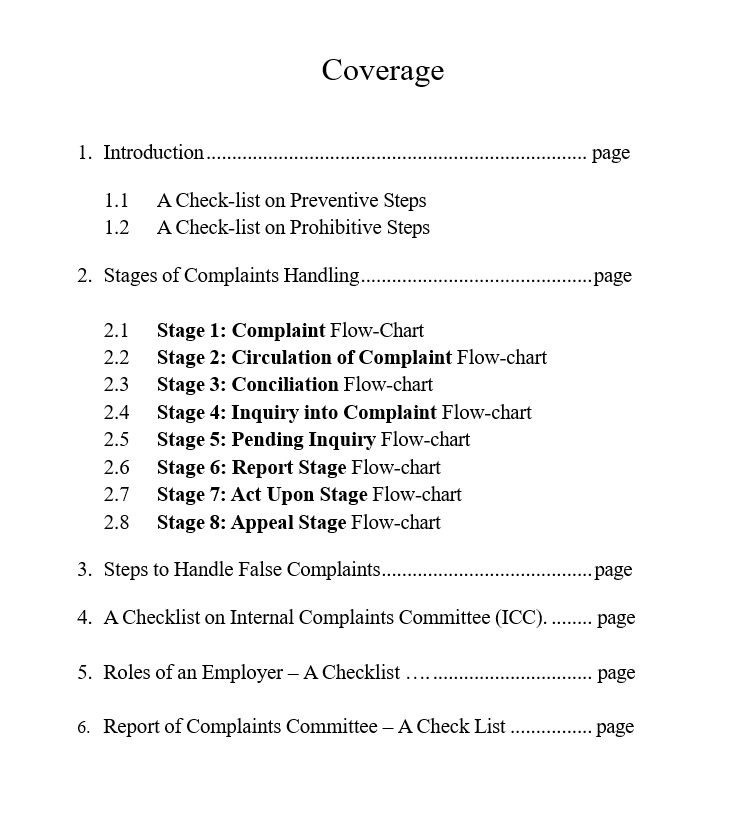
2. Stages of Complaints Handling
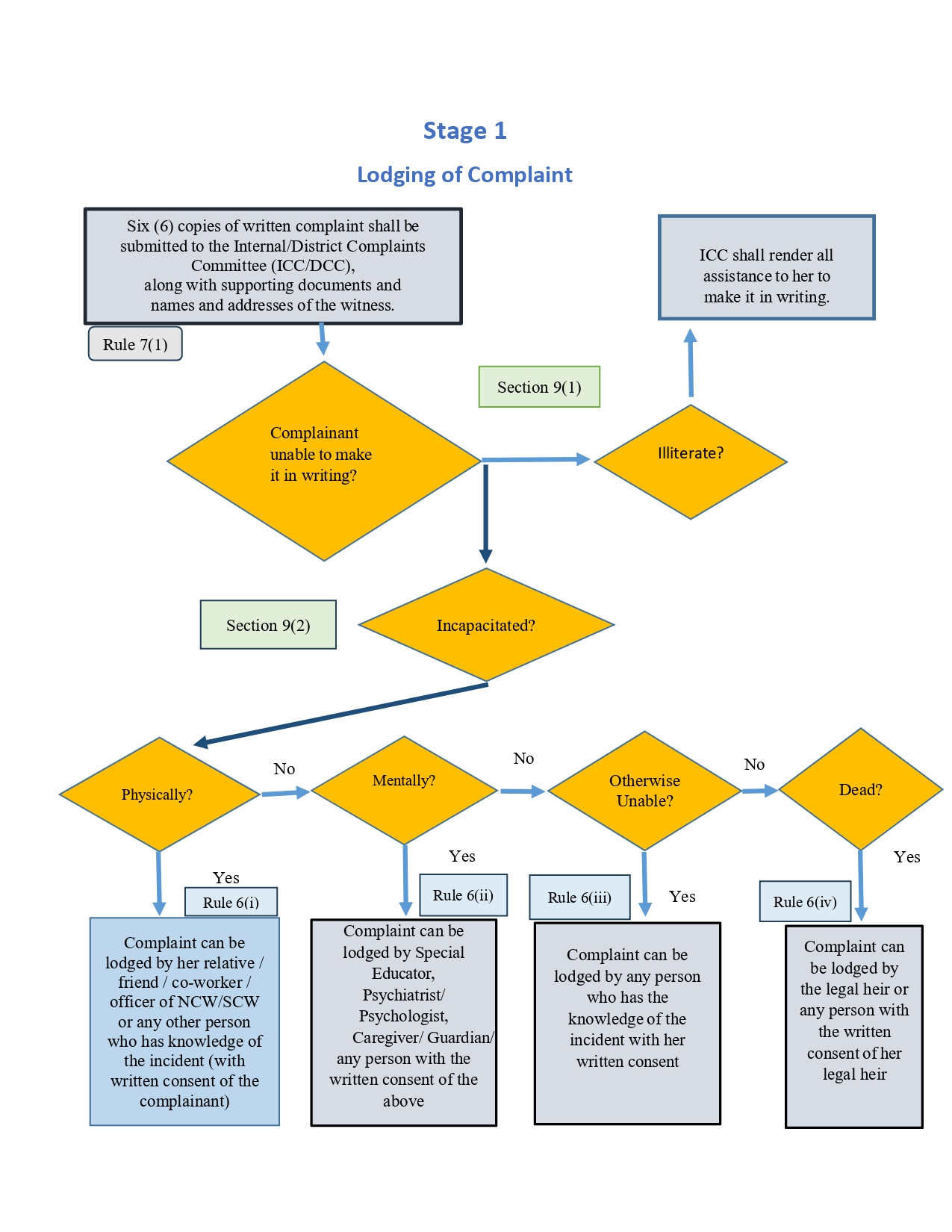
- Stage 1: Lodging of Complaint
- Stage 2: Circulation of Complaint Stage 3: Conciliation
- Stage 4: Inquiry into Complaint
- Stage 5: Pending Inquiry
- Stage 6: Report Stage
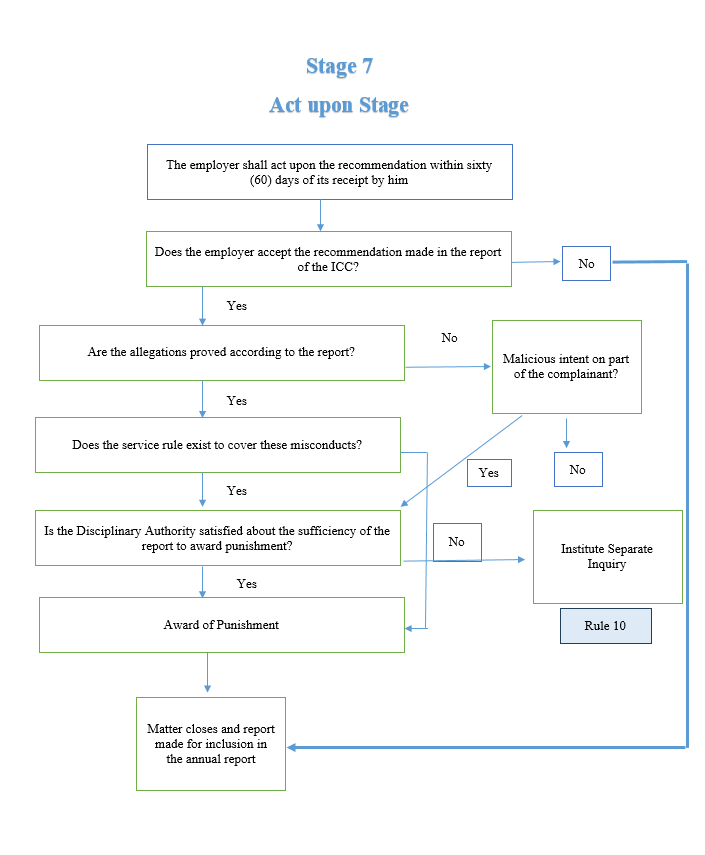
- Stage 7: Act upon Stage
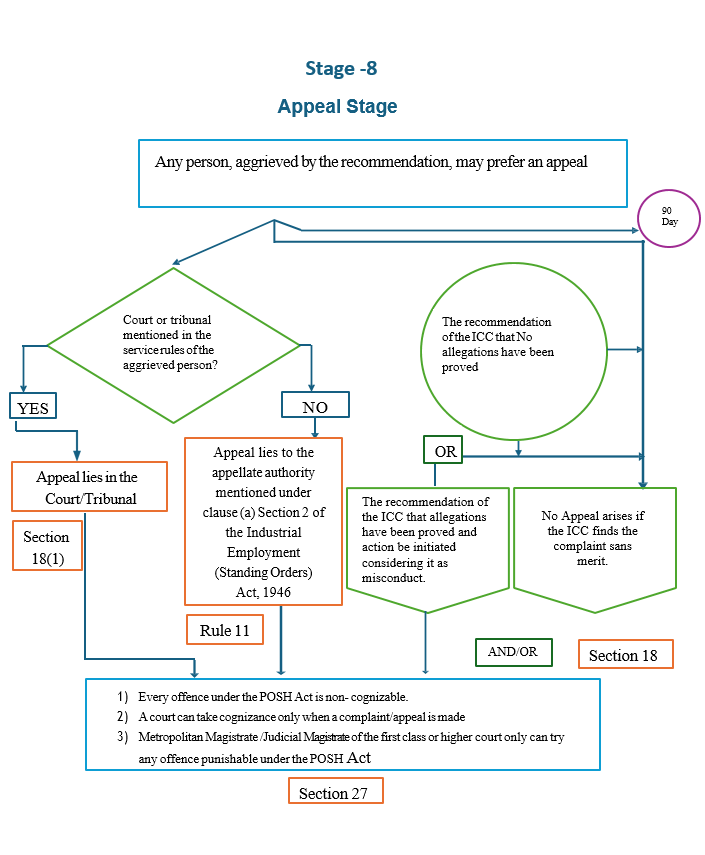
- Stage 8: Appeal Stage
Any woman, aggrieved of being sexually harassed at a workplace, needs to make a complaint in writing before the Internal Complaints Committee (ICC) of the concerned workplace, to avail redress under the Sexual Harassment of Women at Workplace (Prevention, Prohibition and Redressal) Act, 2013 and Rules thereunder.
We shall use the expression “POSH Act” or “The Act” or “POSH Rules” or “The Rules” to refer to the above-mentioned Act and Rules respectively.
If the alleged harassment takes place at a workplace, where there is no ICC, or if the place is not a workplace, the aggrieved woman may lodge her complaint before the concerned Local Complaints Committee (LCC) of the District where the incident of harassment has allegedly happened.
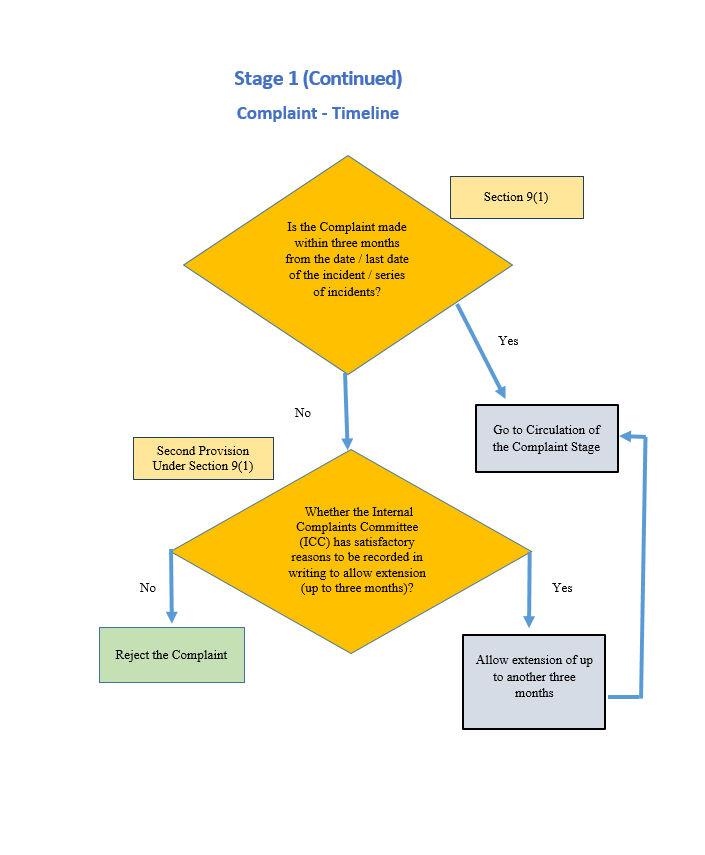
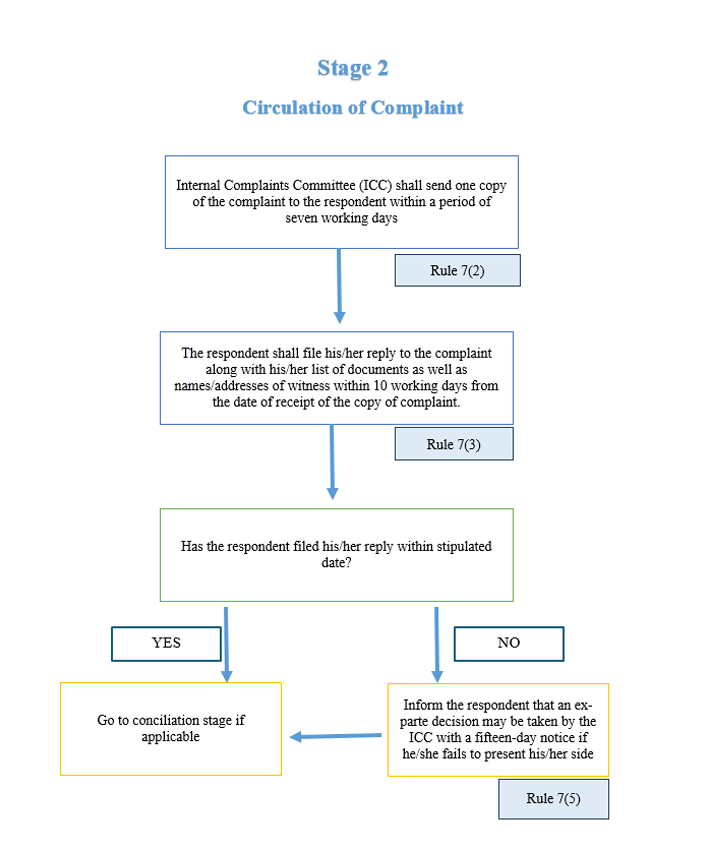
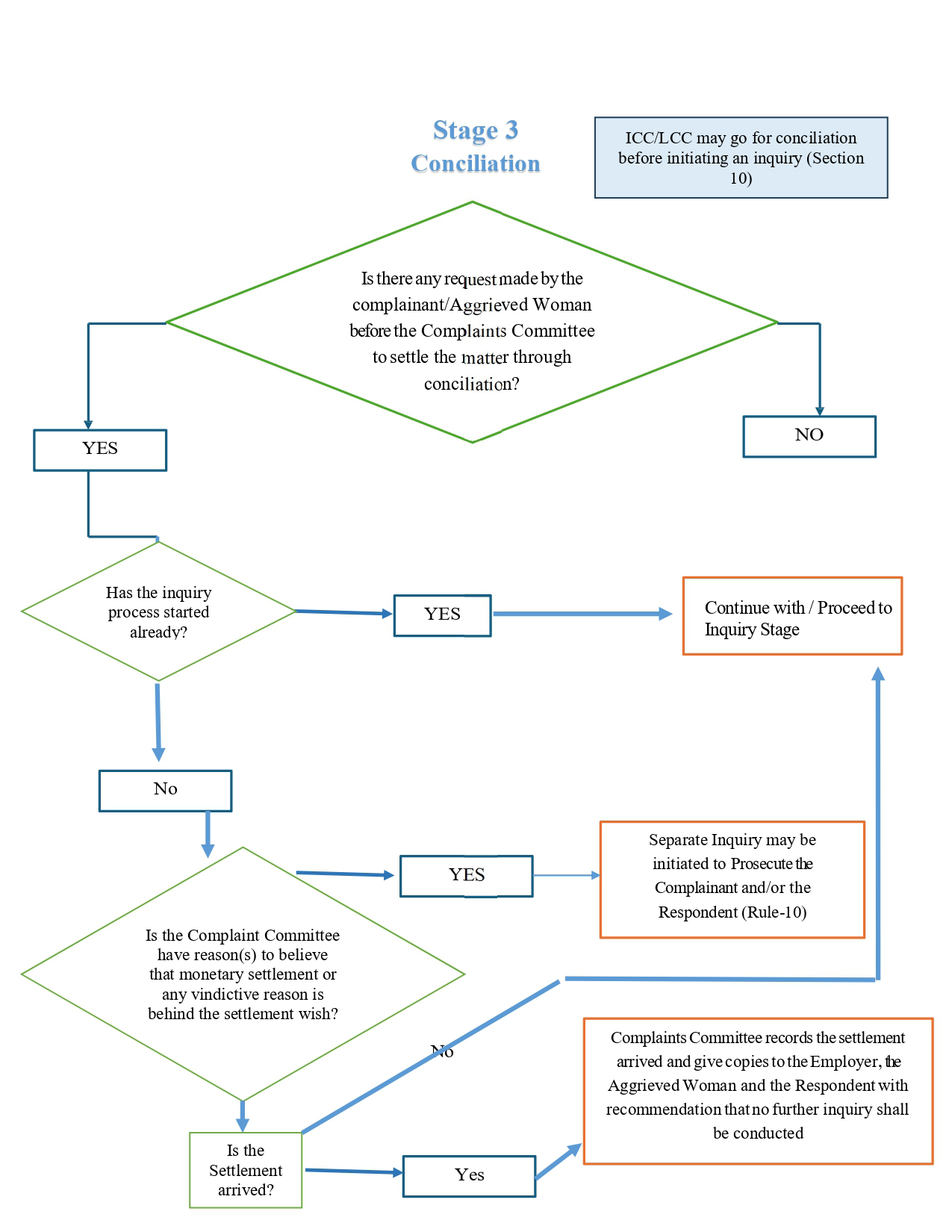
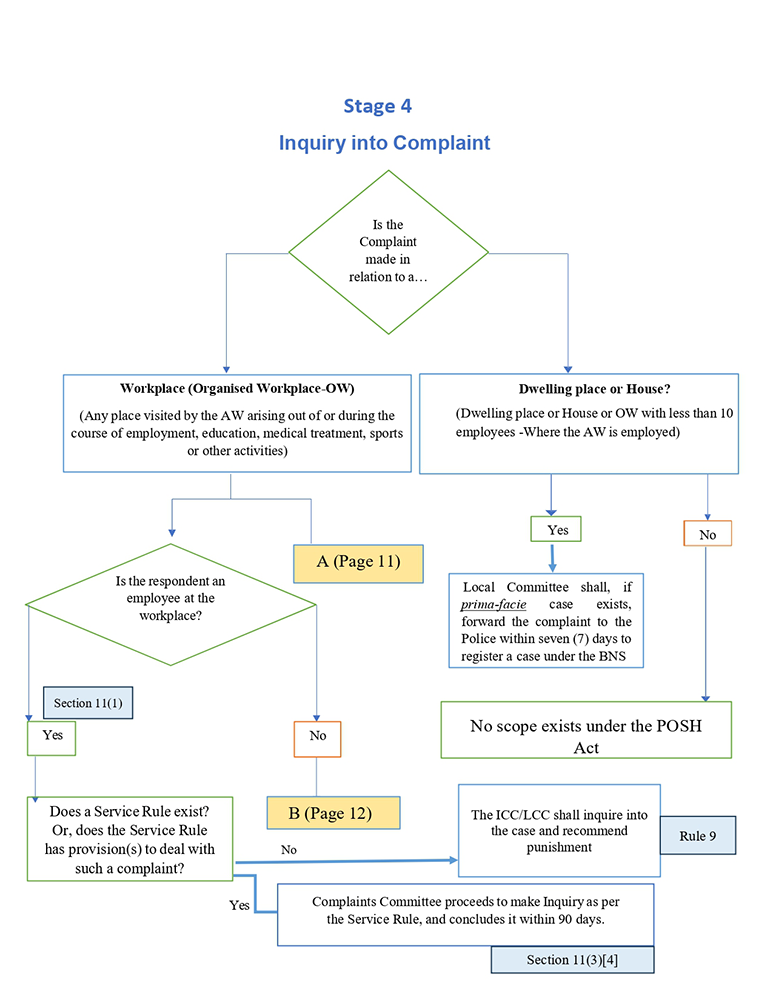
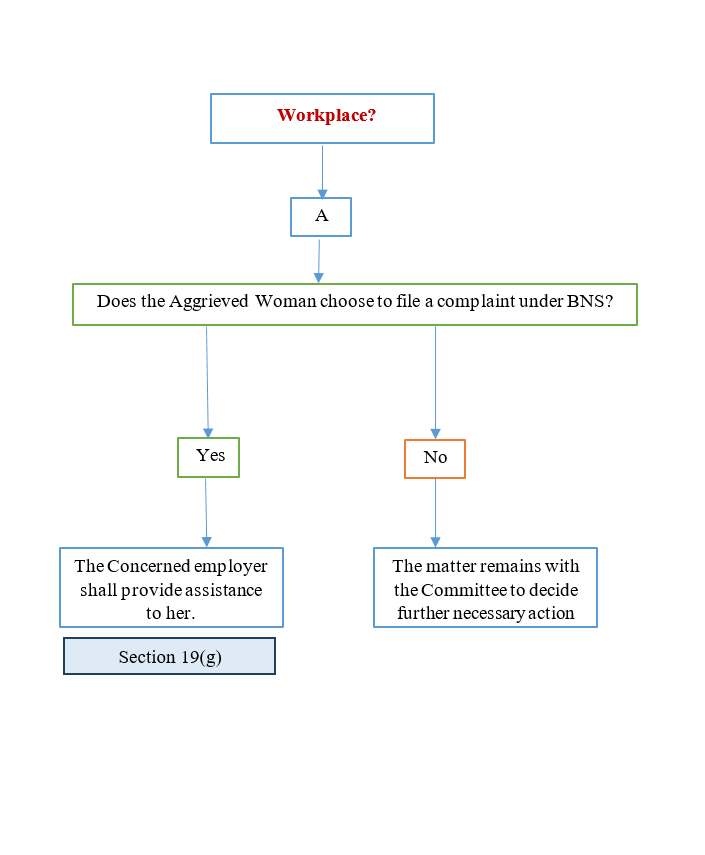
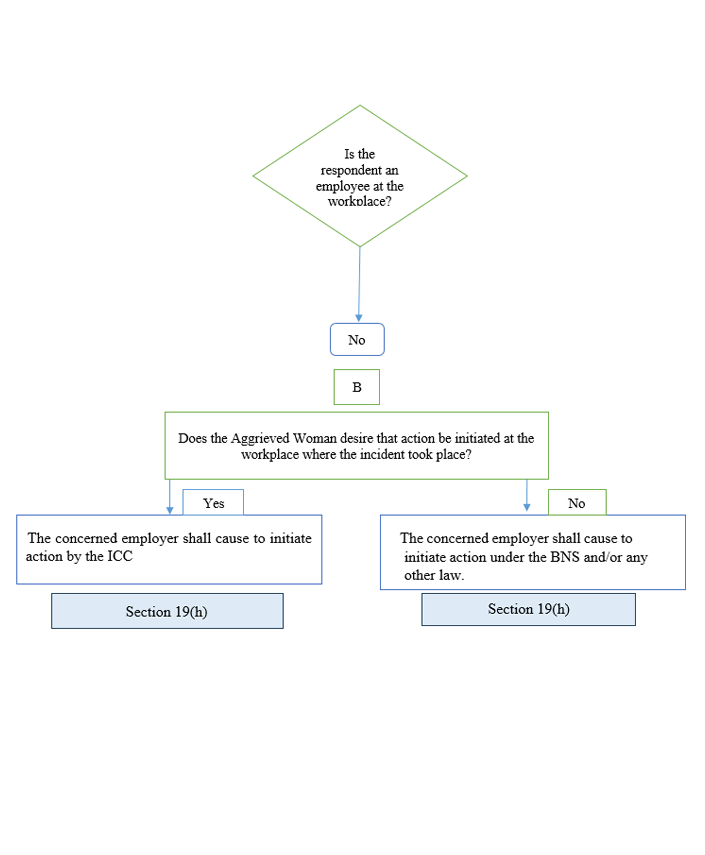
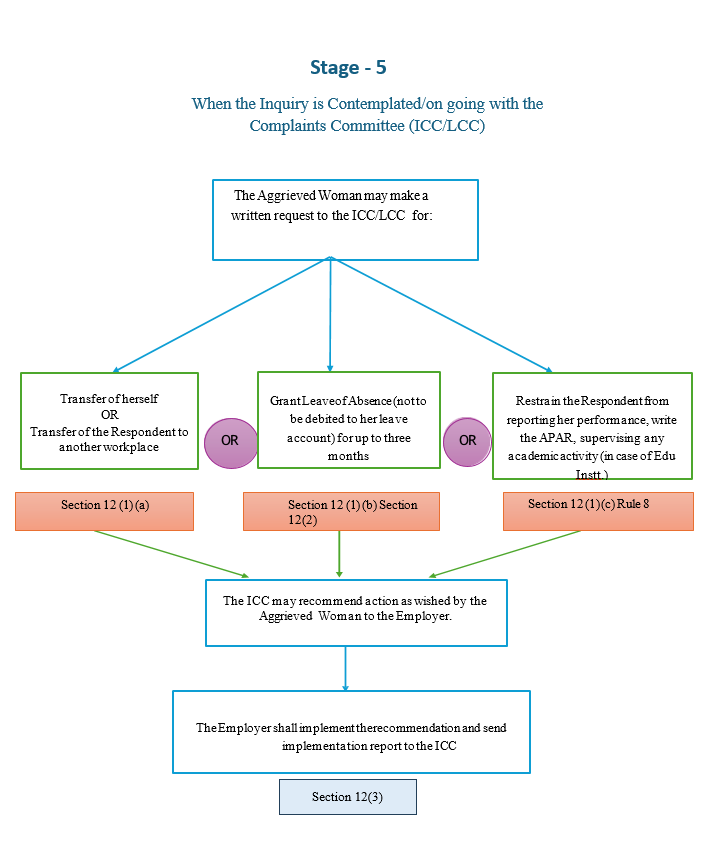
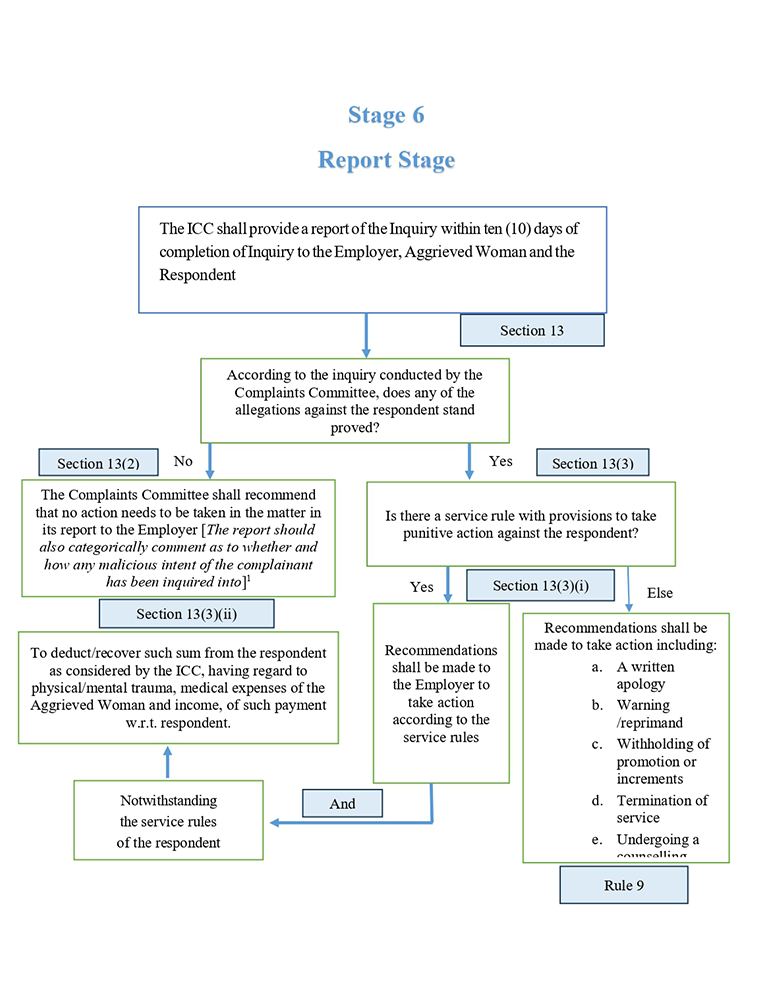
You may look through the Flow-Charts concerning following eight stages of handling of complaints – by the Internal Complaints Committee (ICC):
3. Check Points Against False Complaints
- ICC must educate the complainant or anybody filing the complaint on her behalf that making of a false complaint or producing any false, fabricated and misleading document is a misconduct and action as appropriate may be initiated against the misconduct.
- The complaint must accompany supporting documents and the names and addresses of the witnesses (if available).
- Mere inability to substantiate a complaint or provide adequate proof need not necessarily make a complaint false.
- Production of any misleading or false document knowingly shall amount to making a false complaint.
- The ICC to check any malicious intent on part of the complainant – particularly when the allegations are not proved according to its inquiry.
- If any malicious intent on part of the complainant is established on the basis of an inquiry, and/or any false documents are found to have been produced knowingly, disciplinary action shall be instituted against the complainant as per the service rules, considering the misconduct same as that of sexual harassment; and where no service rules exists, any punishment including the following may be awarded to the complainant:
- A written apology
- Warning /reprimand
- Withholding of promotion or increments
- Termination of service
- Undergoing a counselling session
- Carrying out community service.
Check List on Internal Complaints Committee (ICC)
- An employer must constitute an “Internal Complaints Committee” (ICC) with respect to a workplace employing ten or more employees.
- An ICC may also be referred to as ‘Internal Committee’ or ‘Complaints Committee’ but not named otherwise.
- The constitution of an ICC must be made by an order in writing and the same be made public through website.
- A woman employed at a senior level at the workplace may be nominated by the employer as the “Presiding Officer” of the ICC.
- If no woman at a senior level is available at the workplace concerned, the employer may nominate any other woman of a senior level from another workplace / office / department, as the presiding officer.
- Two or more members from amongst the employees preferably committed to the cause of woman, or who have had experience in social work, or have legal knowledge shall be nominated by the employer as members of the ICC.
- One member from an NGO or an Association committed to the cause of women or a private person familiar with the issues relating to sexual harassment of women shall be nominated by the employer in the ICC.
- Half or more members of the ICC shall be women. The law does not prohibit it if even all of them are women but it is preferable to have male members too in the ICC.
- The employer shall specify the period for how long the Presiding Officer and the members of the ICC will hold office. The period should not exceed three years from the date of nomination.
- The member from the NGO/Association shall be entitled to an allowance of Rs.200/- per day for holding proceedings of the ICC, and also the reimbursement of travel cost in travelling by AC 3-tier class in train or AC Bus or Taxi or auto rickshaw or actual travelling cost – whichever is less.
- The ICC shall make inquiry into the complaint in accordance with the principle of natural justice.
- The ICC shall have the right to terminate the inquiry proceedings or to give an ex-parte decision on the complaint, on giving a notice of minimum fifteen days to the parties concerned, if the complainant or the respondent fails to present herself/himself for three consecutive hearings convened by the Presiding Officer.
- In conducting the inquiry, the ICC must have a minimum of three (3) members including the Presiding Officer, present.
- The ICC shall not allow any party/parties to bring in any legal practitioner to represent them in their case at any stage of proceedings before it.
- The ICC shall accept complaint of sexual harassment from the complainant or her legitimate representative only in writing. Where such complaint cannot be made in writing, the Presiding Officer or any member of the ICC shall render all reasonable assistance to make the complaint in writing.
- ICC should not hold an enquiry on a complaint, which is anonymous or pseudonymous.
- If the ICC is satisfied that the circumstances have been such as to prevent the complainant to file her complaint within the stipulated time of three months, it may extend the time limit by maximum another three months, for reasons to be recorded in writing.
- The ICC may take steps to settle the matter between the aggrieved woman (complainant) and the respondent, if so requested in writing by the complainant. Provided that no monetary settlement shall be made based on such conciliation.
- If the settlement is arrived following the conciliation, the ICC shall make a report to that effect and send the report to the employer, the aggrieved woman and the respondent.
- Where the respondent is an employee, the ICC shall proceed to make an enquiry in to the complaint, notwithstanding who is the complainant, in accordance with the service rules applicable to the respondent and principles of natural justice. Where no provisions in the service rules, or the service rules itself exists, the ICC shall make inquiry to the best of its judgement in accordance with the principles of natural justice.
- Where the respondent is not an employee, the ICC of a workplace, shall proceed to make an enquiry in to the complaint, notwithstanding who is the complainant, if and only if the incident of the alleged sexual harassment took place in the same workplace, on being directed by the employer of the work place, in the event of his being desired so by the complainant.
- Where both, the aggrieved woman and the respondent, are employees of the workplace, the ICC shall give opportunities to be heard to both of them, and share copies of its findings enabling them to make representation against the findings before the ICC itself.
- The ICC shall have the same power as are vested in civil court under the code of Civil Procedure, 1908, for the purpose of making an inquiry, in respect of summoning and enforcing the attendance of any person, and examining him/her on oath; requiring the discovery and production of documents.
- 24. The ICC shall complete the inquiry into a complaint of sexual harassment within a period of ninety days.
- 25. During the pendency of an inquiry, on a written request made by the aggrieved woman, the ICC may recommend to the employer to transfer the aggrieved woman or the respondent to any other workplace, or grant leave to the aggrieved woman up to a period of three months; or restrain the respondent from reporting on her work performance and supervising any academic activity (applicable for academic institution).
- 26. The ICC shall prepare and submit to the employer, in each calendar year an annual report, consisting of:
- Number of complaints of sexual harassment received in the year;
- Number of complaints disposed off during the year;
- Number of cases pending for more than ninety days;
- Number of workshops of awareness programmes against sexual harassment carried out;
- Nature of action taken by the employer.
4. Roles of An Employer – A Check List
Every employer shall -
- Treat sexual harassment as a misconduct under the service rules (if not already treated) and initiate action for such misconduct;
- Provide a safe working environment at the workplace which shall include safety from the persons coming into contact at the workplace;
- Constitute an Internal Complaints Committee (ICC) by an order in writing;
- Make the order constituting the ICC public;
- Display at well lit, easily visible places in the office the order constituting the ICC with names and contact numbers of the Presiding Officer and the members;
- Display what constitutes sexual harassment and its penal consequences at such conspicuous places in the workplace;
- Make sure that the content of any sexual harassment complaint, identities (or particulars calculated to lead to identification) of the aggrieved woman, the respondent, the witnesses, conciliation and/or inquiry proceedings, recommendations of the ICC, action taken by the employer should not be published, communicated or made known to public, press or media;
- Consider any activity leading to disclosure of any of the above, on part of a person entrusted with dealing with complaints of sexual harassment, as misconduct under the service rules (POSH rules, 2013 in absence of service rules);
- Remove the Presiding Officer or any member of the ICC who contravenes the above mentioned non-disclosure provisions, and/or found convicted or guilty of an offence under any law; or that any disciplinary proceedings is pending against her/him or that she/he has so abused her position as to render her/his continuance in the ICC;
- Shall fill up the resultant vacancy created or any casual vacancy(owing to long leave, training or other absence) in the ICC;
- Provide necessary facilities to the ICC for dealing with complaints and conducting of inquiries thereon;
- Assist in securing the attendance of respondent and witnesses before the ICC;
- Make available such information to the ICC as it may be required having regard to the complaint of sexual harassment;
- Transfer the aggrieved woman or the respondent to any other workplace; or grant leave of absence to the aggrieved woman up to a period of three months (in addition to leave she is otherwise entitled); or restrain the respondent from reporting on the work performance / supervising any academic activity of the aggrieved woman – if and only if recommended by the ICC during the pendency of the inquiry – and shall send a report thereof to the ICC;
- Act upon (by either accepting or rejecting) the recommendation of the ICC within a period of sixty days;
- Cause to initiate action, under Bhartiya Naya Sanghita or any other law for the time being in force - if so desired by the aggrieved woman; where the perpetrator is not an employee in the workplace under his jurisdiction;
- Cause to initiate action, in the workplace (through the ICC of that workplace) at which the sexual harassment alleged to have taken place, if so desired by the aggrieved woman (belonging to the workplace under his jurisdiction);
- Provide assistance to the aggrieved woman, if she so chooses, to file a complaint in relation to the alleged sexual harassment under Bhartiya Naya Sanghita or any other law, for the time being in force;
- Monitor the timely submission of reports by the ICC;
- Include the number of cases filed, if any, and their disposal under the POSH Act in the Annual Report of his organisation;
- Intimate the concerned District Officer, number of cases filed under the POSH Act, if no Annual Report is to be prepared by the organisation;
- Produce on demand, before the officer representing the appropriate government, making the inspection relating to the complaints filed under the POSH Act, all information, records and documents in his custody – having bearing on subject matter of inspection; [Section 25(2)]
Any Employer may -
Disseminate information regarding the justice secured to any victim of sexual harassment at the concerned workplace, without disclosing particulars mentioned above of the concerned parties.
5. Report of the ICC – A Check List
General
- Have the six (6) copies of complaints been received in writing?
- Are all copies duly signed (or thumb-impression), and dated?
- Has the complainant made the complaint herself? If not her, who has made the complaint on her behalf?
- Is the complaint maker (other than the aggrieved woman herself) eligible to make a complaint (with written consent of the aggrieved woman, where applicable)?
- What is the date of complaint?
- Is it within the stipulated time of three months?
- If not, has the extension been granted?
- If yes, the period of extension granted and justification therefor.
- Mention whether any supporting documents and/or name(s) of the witnesses are enclosed with the complaint.
- If no supporting documents and/or name(s) of witnesses attached, mention the reason therefor.
- 11. Are the both (aggrieved woman and respondent) employees in the workplace (the ICC is concerned with)?
- If not, is the respondent named in the complaint an employee of the workplace (the ICC is concerned with)?
- If not, is the aggrieved woman not an employee of the workplace? If so, in addition, has the employer directed the ICC to look into the complaint of sexual harassment alleged to have happened in the workplace?
- Mention the date on which the respondent has received a copy of the complaint, forwarded by the ICC, along with a clear instruction to file a written reply within fifteen (15) days.
- Mention whether the respondent has filed a written reply, and if so on which date.
- Has the aggrieved woman made a request for conciliation to the ICC before institution of inquiry?
- If so, mention the date of the request, whether and how the conciliation has been attempted, and the settlement arrived at, specifically mentioning that there has been no monitory settlement.
- If a settlement is arrived, prepare a report for the employer – either recommending no further action, or soliciting orders to inquire into malicious intent on part of the complainant, with sufficient ground for suspicion.
Conciliation
- A copy of the report must be given to each of the complainant and the respondent, and a copy duly signed (thumb impression) of both in token of agreement must be given to the employer.
- If there is no request for conciliation, or no settlement arrived through conciliation, mention in detail how efforts have been made to find the facts, corroborating with evidences and transcripts of conversation with witnesses, with respect to the alleged sexual harassment.
- Mention what actions have been taken to ascertain the truth, and if any truth has been ascertained with respect to the alleged sexual harassment.
- If no truth is ascertained for sure, mention what the committee has ascertained about the nature, personality, behaviour, and demeanour of past and present with respect to both the aggrieved woman and the respondent.
- If both the aggrieved woman and the respondent are employees of the workplace, mention whether and how the findings (without any recommendations) have been shared with both the respondent and the aggrieved woman.
- In the above situation, mention how has the ICC provided the opportunities of being heard to both the parties and how many times, with dates and outcome.
- 25. Mention if any or both of the parties have represented against the findings of the ICC; what transpires from such representation(s) and the specific takes of the ICC thereupon.
- Mention if the ICC has made any recommendation to the employer any relief for the aggrieved woman pending the completion of the inquiry, and whether any report of compliance thereupon has been received from the employer;
- Mention if any of the parties has approached any court/tribunal (as per applicable service rules) or labour court (otherwise) with an appeal on quantification/ nature / fulfilment or non-fulfilment of interim relief or whether the ICC is unaware of any such;
- Finally, the report should mention whether the ICC has requested for any assistance of the employer, and whether and how the employer has extended it.
- Before conclusion, please mention in a paragraph how the principles of natural justice have been upheld in the entire inquiry process.
Inquiry
Conclusion
30. On conclusion of the inquiry, the ICC shall mention in the report if the allegation against the response has been proved; or not proved; or if there exists preponderance of probability indicating likelihood of delinquencies on part of the respondent. In case the allegation has not been proved, the ICC must comment on inquiry conducted to discover malicious intent on part of the aggrieved women; and whether any such is proved.
Recommendation
31. The ICC, if the allegation is proved against the respondent, must recommend to the employer to take punitive action against him/her in accordance with the service rules. If the service rules are not existing, the recommendations must be made to the employer to take any action against the respondent, including (but not limited to) a written apology, warning, reprimand or censure, withholding of promotion, withholding of pay rise or increments, terminating the respondent from service, or undergoing a counselling session or carrying out community service, depending on the gravity of the delinquency. If the allegation against the respondent is not proved, but malicious intent on part of the complainant is established, similar punitive action against her shall be recommended by the ICC.
Documents to be enclosed
32. The ICC, along with its report, must enclose the list of evidences and witnesses relied upon, the transcript of the respondent’s, aggrieved woman’s and witnesses’ submission, the dates of the inquiry held, the list of the members including the Presiding Officer present during the inquiry and any representation received from either the respondent or the aggrieved woman or both.